Introduction
APIs have become one of the most important building blocks of modern digital technology. Websites, mobile applications, cloud platforms, SaaS products, financial services, healthcare systems, and artificial intelligence applications all depend on APIs to exchange data and communicate with other systems.
As API usage continues to expand, attackers are also focusing more attention on API endpoints. Traditional cybersecurity tools alone may not provide enough protection for increasingly complex API environments. Organizations now need stronger authentication, better authorization, continuous monitoring, automated threat detection, and comprehensive API lifecycle management.
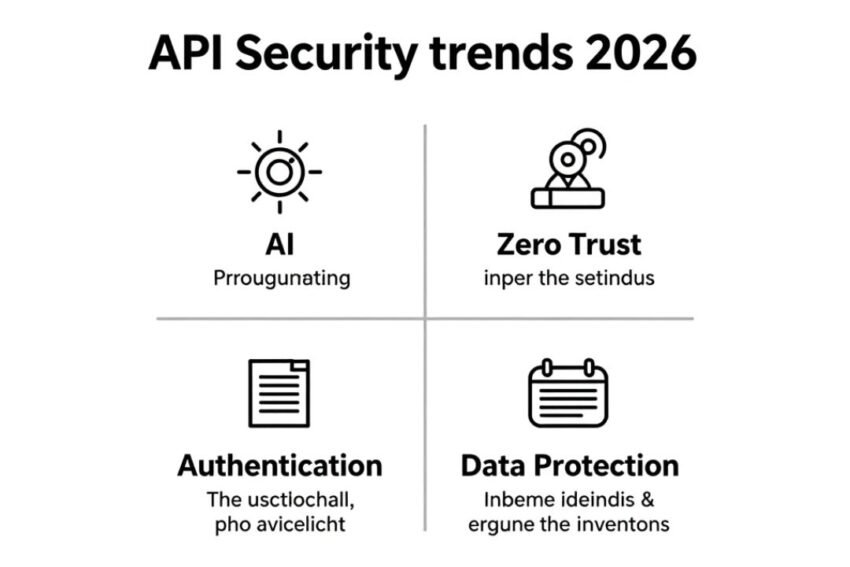
In 2026, several important developments are shaping the future of API security. Artificial intelligence, Zero Trust architecture, advanced authentication, API discovery, automated testing, behavioral analytics, and data protection are becoming increasingly important.
This guide explores the top API security trends in 2026, why they matter, and how businesses can use them to protect modern APIs.
What Is API Security?
API security refers to the technologies, practices, and processes used to protect APIs from unauthorized access, attacks, data exposure, and misuse.
APIs often provide access to important business functions and sensitive information. A compromised API could potentially expose customer records, financial information, authentication systems, or internal services.
Effective API security focuses on several areas, including:
- Authentication
- Authorization
- Encryption
- Access control
- Rate limiting
- Threat detection
- API monitoring
- Security testing
- Data protection
- API lifecycle management
As organizations adopt more APIs, protecting the entire API environment becomes increasingly important.
Why API Security Is More Important in 2026
Modern applications are becoming increasingly connected.
A single application may communicate with:
- Cloud platforms
- Databases
- Payment providers
- AI services
- Mobile applications
- SaaS platforms
- Internal microservices
- Third-party APIs
This creates a large and complicated attack surface.
At the same time, automated attacks can scan and interact with APIs at very high speeds. Attackers may attempt credential abuse, authorization bypasses, data extraction, injection attacks, or resource exhaustion.
Organizations therefore need security strategies that can detect unusual behavior quickly and protect APIs continuously.
1. AI-Powered API Security
One of the biggest API security trends in 2026 is the growing use of artificial intelligence for security monitoring and threat detection.
Traditional security systems often depend on predefined rules. AI-powered systems can analyze large amounts of API activity and identify unusual patterns.
For example, AI may detect:
- Abnormal request behavior
- Unusual login patterns
- Unexpected data access
- Automated attacks
- Suspicious API sequences
- Abnormal traffic spikes
AI can also help security teams investigate alerts and prioritize potentially dangerous events.
However, AI should complement strong security controls rather than replace authentication, authorization, and secure development practices.
2. Zero Trust API Security
Zero Trust is becoming increasingly important for API protection.
The basic principle is simple:
Never automatically trust a user, device, application, or service.
Every request should be evaluated according to identity, permissions, context, and security policies.
For APIs, Zero Trust can involve:
- Strong authentication
- Fine-grained authorization
- Service identity
- Continuous verification
- Least-privilege access
- Network segmentation
- Detailed monitoring
Zero Trust is especially useful in cloud and microservices environments where services constantly communicate with each other.
3. Stronger API Authentication
Authentication remains one of the most important parts of API security.
In 2026, organizations are increasingly focusing on stronger identity mechanisms instead of relying on simple API keys or passwords alone.
Modern authentication strategies may include:
- OAuth 2.0
- OpenID Connect
- Short-lived access tokens
- JSON Web Tokens
- Mutual TLS
- Multi-factor authentication
- Workload identity
The appropriate approach depends on the API architecture and security requirements.
For highly sensitive applications, organizations should avoid unnecessarily long-lived credentials and should have processes for rotating and revoking credentials.
4. Advanced API Authorization
Authentication tells an API who is making a request. Authorization determines what that identity can actually access.
Weak authorization remains a major API security risk.
Modern applications increasingly require fine-grained authorization that considers:
- User identity
- User role
- Resource ownership
- Application context
- Device information
- Business rules
For example, a customer should be allowed to view their own account information but not another customer’s private records.
Organizations should enforce authorization on the server for every sensitive resource and function.
5. Automated API Discovery
Many businesses do not have a complete understanding of all the APIs operating in their environments.
Development teams may create new APIs quickly, while old versions, testing endpoints, and undocumented services remain active.
Automated API discovery can help organizations identify:
- Public APIs
- Internal APIs
- Shadow APIs
- Legacy endpoints
- Unknown services
- API versions
- Sensitive data flows
Maintaining an accurate API inventory allows security teams to identify risks more effectively.
6. API Security Testing
Security testing is becoming increasingly integrated into modern development workflows.
Instead of testing APIs only before major releases, organizations can incorporate security checks throughout development and deployment.
Important API security testing methods include:
- Vulnerability scanning
- Penetration testing
- Fuzz testing
- Authentication testing
- Authorization testing
- Input validation testing
- API specification analysis
- Dependency scanning
Automated testing can help developers identify vulnerabilities earlier in the software development lifecycle.
7. Behavioral API Monitoring
API security is moving beyond simple signature-based detection.
Behavioral monitoring focuses on understanding what normal API activity looks like and identifying unusual behavior.
For example, an API may normally receive a few hundred requests from a particular service. A sudden increase to thousands of requests could indicate abuse or an automated attack.
Behavioral monitoring can help detect:
- Account takeover attempts
- Data scraping
- Credential abuse
- Bot activity
- API enumeration
- Unusual resource access
Combining behavioral analytics with other security controls can improve threat detection.
8. Better Rate Limiting and API Abuse Protection
Rate limiting remains an important API security practice in 2026.
Organizations can limit how frequently clients are allowed to call particular endpoints.
Different APIs may require different limits.
For example:
- Login endpoints may require strict limits.
- Public product searches may allow higher limits.
- Payment operations may require additional protection.
- Resource-intensive AI APIs may need usage quotas.
Advanced rate-limiting systems can consider identity, application, endpoint, traffic patterns, and historical behavior.
This helps reduce automated abuse and resource exhaustion.
9. API Gateways as Security Layers
API gateways are becoming increasingly important as centralized control points.
An API gateway can help organizations manage:
- Authentication
- Authorization
- Routing
- Rate limiting
- Traffic policies
- Logging
- API versioning
- Security controls
Centralized API management can make it easier to apply consistent security policies across multiple services.
However, organizations should not rely entirely on the gateway. Applications should still enforce critical security controls at the service level.
10. Protection Against Shadow and Zombie APIs
Shadow APIs are APIs that are not properly documented or managed by security teams.
Zombie APIs are older endpoints that should have been retired but remain accessible.
Both can create serious security risks.
Organizations are increasingly using API discovery and lifecycle management tools to identify these endpoints.
A strong API governance strategy should include:
- API ownership
- Version management
- Documentation
- Security reviews
- Deprecation policies
- Retirement procedures
Removing unnecessary APIs can reduce the overall attack surface.
11. API Data Protection
APIs often handle sensitive information, making data protection a major security priority.
Organizations should carefully control what data APIs return.
Security teams should consider:
- Data minimization
- Encryption
- Access controls
- Token protection
- Data classification
- Secure storage
- Privacy requirements
An API should generally return only the information required for the requested operation.
Reducing unnecessary data exposure can limit the impact of a compromised account or endpoint.
12. API Security for AI Applications
The rapid growth of AI is creating new API security requirements.
AI applications frequently communicate through APIs to access:
- Large language models
- AI agents
- Databases
- Enterprise systems
- External services
- Automation tools
AI agents may also make API calls automatically based on instructions and available tools.
This creates new security concerns.
Organizations need to control which APIs AI systems can access and what actions they are allowed to perform.
Important controls may include:
- Strong service identity
- Fine-grained permissions
- API quotas
- Request monitoring
- Data protection
- Human approval for sensitive operations
AI-driven automation makes API authorization even more important.
13. API Security for Microservices
Microservices architectures depend heavily on APIs.
Instead of one large application, organizations may operate dozens or hundreds of smaller services.
These services communicate through APIs, creating complex service-to-service relationships.
Security strategies for microservices can include:
- Service authentication
- Mutual TLS
- Least-privilege permissions
- Network segmentation
- Service identity
- Centralized logging
- Continuous monitoring
Zero Trust principles can be especially useful in microservices environments.
14. Continuous API Security
Security is increasingly becoming a continuous process.
Organizations cannot assume that an API is secure simply because it passed a security test before deployment.
APIs change frequently as developers add:
- New endpoints
- New parameters
- New integrations
- New authentication methods
- New business logic
Continuous monitoring and testing help organizations detect security problems as APIs evolve.
15. API Security Automation
Automation can improve the speed and consistency of security operations.
Security automation can help with:
- API discovery
- Vulnerability scanning
- Credential rotation
- Threat detection
- Alert generation
- Security testing
- Compliance monitoring
Automation is especially valuable for organizations managing large API environments.
It allows security teams to focus more attention on complex incidents instead of repetitive manual tasks.
API Security Best Practices for 2026
Organizations can strengthen their API security strategy by following these practices:
Use Strong Authentication
Use appropriate authentication mechanisms and protect credentials carefully.
Enforce Authorization
Verify permissions for every sensitive operation and resource.
Encrypt API Traffic
Use HTTPS and modern TLS configurations.
Apply Rate Limiting
Prevent excessive requests and automated abuse.
Maintain an API Inventory
Know which APIs exist, who owns them, and what data they handle.
Remove Old APIs
Retire unnecessary and outdated API versions.
Monitor API Activity
Look for unusual requests, traffic patterns, and access behavior.
Test APIs Regularly
Perform automated and manual security testing.
Minimize Data Exposure
Return only the data required by each request.
Adopt Zero Trust
Verify identities and permissions rather than automatically trusting network locations.
API Security for Cloud Applications
Cloud applications often depend on many APIs.
Cloud services may communicate with databases, storage systems, authentication providers, third-party platforms, and internal applications.
This means cloud API security should include:
- Identity management
- Access control
- Encryption
- Network security
- Monitoring
- Secrets management
- API inventory
Organizations should also review third-party integrations because external services can introduce additional risks.
Challenges of API Security in 2026
Despite advances in security technology, API protection remains challenging.
Common problems include:
- Large API environments
- Legacy systems
- Shadow APIs
- Complex permissions
- Third-party integrations
- Rapid development
- AI-generated applications
- Increasing automated attacks
Security teams must also avoid creating excessive friction for developers and legitimate users.
The best API security strategies combine strong controls with automation and developer-friendly security practices.
The Future of API Security
The future of API security will likely involve greater automation, intelligence, and identity-based controls.
AI-powered monitoring may help security teams identify complex attack patterns.
Zero Trust architecture may become more common as organizations move toward distributed applications.
Automated API discovery will help businesses identify previously unknown endpoints.
Meanwhile, stronger authentication and authorization technologies will help control access between users, applications, services, and AI agents.
API security will also become increasingly connected to broader application security and cloud security programs.
Conclusion
API security in 2026 is becoming more advanced as businesses rely on APIs for cloud applications, mobile services, microservices, SaaS platforms, and artificial intelligence.
The most important trends include AI-powered threat detection, Zero Trust API security, stronger authentication, fine-grained authorization, automated API discovery, continuous security testing, behavioral monitoring, advanced rate limiting, API data protection, and security automation.
Organizations should not treat API security as a single product or tool. It requires a combination of secure development, identity management, authorization, encryption, monitoring, testing, governance, and continuous improvement.
As AI agents and automated applications become more capable, APIs will increasingly act as the connection between intelligent software and real-world systems. This makes strong identity and permission controls especially important.
Businesses that adopt modern API security best practices can reduce their attack surface, protect sensitive information, and build more resilient digital services.
The future of cybersecurity will depend heavily on protecting the connections between applications, services, users, and intelligent systems—and APIs will remain at the center of that connected digital environment.