Introduction
Cybersecurity has changed dramatically as businesses move their applications, data, and employees beyond traditional office networks. Cloud computing, remote work, mobile devices, SaaS applications, APIs, artificial intelligence, and connected devices have created a much larger digital attack surface.
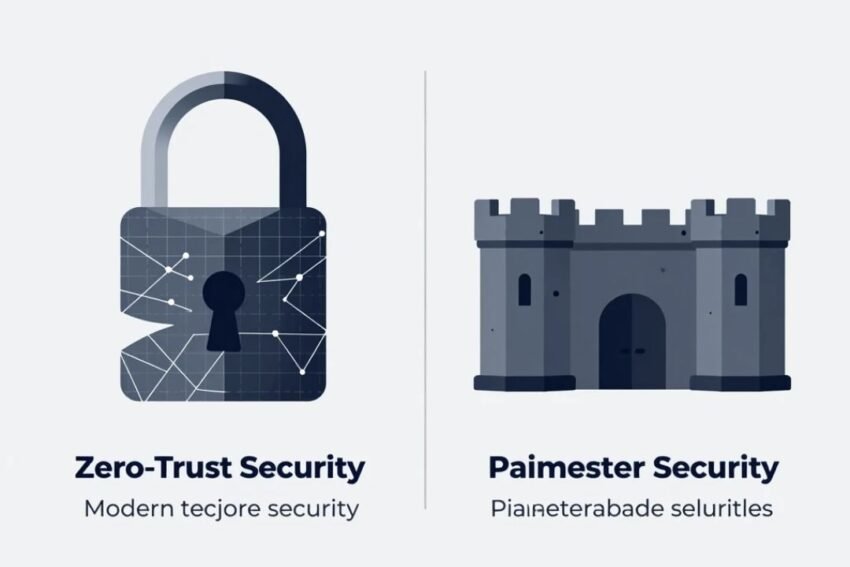
For many years, organizations primarily relied on traditional network security. This approach focused on creating a strong perimeter around corporate systems. Users and devices inside that perimeter were often treated as trusted, while traffic coming from outside was considered more dangerous.
Today, this model is increasingly difficult to maintain.
Zero Trust Security introduces a different approach. Instead of automatically trusting users or devices because they are inside a network, Zero Trust requires access requests to be verified and continuously evaluated.
The comparison between Zero Trust vs traditional security is therefore important for organizations looking to modernize their cybersecurity strategy.
This guide explains the major differences, benefits, challenges, and solutions associated with both security models and explores why Zero Trust is becoming increasingly important for modern networks.
What Is Traditional Security?
Traditional security is often based on the idea of protecting a defined network perimeter.
Organizations may use technologies such as:
- Firewalls
- VPNs
- Network intrusion prevention
- Antivirus software
- Network segmentation
- Password-based authentication
- Security gateways
The basic idea is to keep unauthorized users outside the corporate network while allowing trusted users inside.
Once a user successfully enters the network, they may receive relatively broad access to internal resources.
This model can work effectively in controlled environments, but modern organizations are no longer limited to one physical office or data center.
What Is Zero Trust Security?
Zero Trust Security is a cybersecurity model based on the principle:
Never trust, always verify.
Zero Trust assumes that no user, device, application, or connection should automatically be trusted.
Every access request is evaluated according to factors such as:
- User identity
- Device security
- Resource sensitivity
- Application
- Location
- Behavior
- Authentication strength
- Risk level
Instead of protecting only the network perimeter, Zero Trust attempts to protect individual applications, users, devices, workloads, and data.
Zero Trust vs Traditional Security: Key Difference
The biggest difference is the concept of trust.
Traditional security often follows a model similar to:
Verify at the perimeter → Trust inside
Zero Trust follows:
Verify continuously → Trust nothing automatically
This distinction changes how organizations design access controls and security policies.
Traditional Security Architecture
Traditional security commonly uses a centralized perimeter.
A simplified model looks like:
Internet → Firewall → Corporate Network → Internal Resources
Employees connect to the corporate network, often through a VPN when working remotely.
After authentication, users may be able to access several internal systems.
This model creates a strong boundary, but attackers who successfully compromise an account or device may potentially move further into the internal environment.
Zero Trust Architecture
Zero Trust uses identity and policy-based access.
A simplified model looks like:
User/Device → Verification → Policy Evaluation → Specific Resource
The user does not automatically receive broad network access.
Instead, the system evaluates whether that particular request should be allowed.
For example, an employee may be allowed to access a specific business application but denied access to a sensitive database.
Zero Trust vs Traditional Security Comparison
| Feature | Traditional Security | Zero Trust Security |
|---|---|---|
| Trust model | Trust inside the network | Verify every request |
| Main focus | Network perimeter | Identity, devices, applications and data |
| Authentication | Often at login | Continuous and risk-based |
| Access | Can be broad | Least privilege |
| Remote work | Often VPN-focused | Application-level access |
| Network segmentation | Commonly limited | Microsegmentation |
| Cloud support | Can require adaptation | Designed for distributed environments |
| Monitoring | Often network-focused | Continuous identity and behavior monitoring |
| Lateral movement | Greater potential | More restricted |
| Security philosophy | Perimeter defense | Assume breach |
1. Identity Security
Identity is central to Zero Trust.
Traditional environments may place greater emphasis on network location.
Zero Trust instead asks:
Who is requesting access?
Identity security can include:
- Multi-factor authentication
- Single sign-on
- Passwordless authentication
- Identity governance
- Risk-based authentication
- Privileged access management
This makes identity one of the most important security boundaries.
2. Multi-Factor Authentication
Both traditional and Zero Trust environments can use MFA, but Zero Trust places stronger emphasis on identity verification.
MFA requires users to provide additional proof beyond a password.
Examples include:
- Authentication applications
- Passkeys
- Hardware security keys
- Biometrics
- One-time verification codes
MFA can significantly reduce the risk associated with stolen passwords.
3. Least-Privilege Access
Traditional security environments can sometimes provide users with broad internal access once they successfully connect.
Zero Trust uses least privilege.
Users receive only the permissions necessary to perform their tasks.
For example, an employee who needs access to a sales application may not need access to financial databases or server-management systems.
This limits the potential damage caused by compromised accounts.
4. Network Segmentation vs Microsegmentation
Traditional security may divide networks into several major zones.
Zero Trust can take this concept further with microsegmentation.
Microsegmentation creates smaller security boundaries around workloads, applications, and sensitive systems.
If attackers compromise one system, microsegmentation can make it more difficult for them to move laterally.
This is particularly important for ransomware defense.
5. Remote Work Security
Remote work has exposed some limitations of traditional perimeter-based security.
Employees may connect from:
- Homes
- Hotels
- Airports
- Cafes
- Mobile networks
- Personal devices
Traditional approaches often rely heavily on VPNs.
Zero Trust can provide application-specific access instead.
Rather than placing a remote user directly onto a corporate network, Zero Trust Network Access (ZTNA) can provide access only to authorized applications and resources.
6. Cloud Security
Traditional network security was largely designed around physical infrastructure and controlled corporate networks.
Cloud environments are much more distributed.
Organizations may use:
- Public cloud
- Private cloud
- Hybrid cloud
- SaaS applications
- Containers
- Serverless services
Zero Trust can apply identity-based access controls across these environments.
This makes it easier to create security policies that follow users and resources rather than depending entirely on network location.
7. Application Security
Zero Trust treats applications as important security boundaries.
Organizations can define exactly who should access an application and under what conditions.
Security policies can consider:
- User identity
- Device health
- Application sensitivity
- Location
- Risk level
This approach reduces unnecessary access.
8. Data Security
Traditional security often emphasizes protecting the network that contains data.
Zero Trust focuses more directly on the data itself.
Organizations can classify information as:
- Public
- Internal
- Confidential
- Highly sensitive
Access policies can then be applied according to data sensitivity.
Additional controls may include:
- Encryption
- Data Loss Prevention
- Access logging
- Activity monitoring
- Secure backups
9. Continuous Monitoring
Traditional security may focus heavily on detecting threats at the network perimeter.
Zero Trust encourages continuous monitoring.
Security teams can monitor:
- Login behavior
- Device activity
- Application usage
- Data access
- Network connections
- Administrative actions
If a user’s behavior changes significantly, the organization can increase verification requirements or restrict access.
10. Zero Trust and AI Security
Artificial intelligence is creating new security challenges.
AI applications and AI agents may interact with sensitive systems, APIs, databases, and business applications.
Zero Trust principles can help control these interactions.
For example, an AI agent should not automatically receive unrestricted access to a company’s entire database.
Instead, it should receive only the permissions required for its specific task.
This approach can reduce the risk of excessive AI permissions.
11. Zero Trust and Ransomware Protection
Ransomware attacks often become more damaging when attackers move laterally after compromising an initial system.
Traditional perimeter security may not prevent this movement if the attacker has already entered the internal network.
Zero Trust can reduce lateral movement through:
- Least privilege
- Microsegmentation
- MFA
- Identity monitoring
- Device verification
- Application-level access
Secure and isolated backups remain essential because no security model can guarantee complete protection against ransomware.
Benefits of Traditional Security
Traditional security still has useful applications.
Simple Architecture
A perimeter-based model can be relatively straightforward to understand.
Established Technology
Firewalls, VPNs, antivirus, and network security tools remain important components of cybersecurity.
Useful for Controlled Environments
Organizations with highly controlled networks may still benefit from traditional security controls.
Strong Network Protection
Firewalls and network monitoring can provide valuable protection against unauthorized traffic.
However, traditional security works best when combined with modern identity, endpoint, application, and data security controls.
Benefits of Zero Trust Security
Zero Trust offers several advantages for modern organizations.
Reduced Attack Surface
Users receive less unnecessary access.
Better Identity Protection
Identity becomes a central security control.
Reduced Lateral Movement
Microsegmentation and least privilege can limit attacker movement.
Stronger Cloud Security
Policies can be applied across distributed environments.
Improved Remote Access
Users can receive application-specific access instead of broad network access.
Better Visibility
Continuous monitoring can provide more detailed information about users, devices, and applications.
Challenges of Traditional Security
Traditional security can face several limitations in modern environments.
These include:
- Overreliance on network boundaries
- Broad internal access
- VPN limitations
- Difficulty supporting cloud environments
- Increased lateral movement risk
- Complex remote-access requirements
This does not mean traditional tools are obsolete. Instead, organizations need to integrate them into a broader modern security strategy.
Challenges of Zero Trust
Zero Trust also introduces challenges.
Implementation Complexity
Large organizations may have thousands of users, devices, applications, and policies.
Legacy Systems
Older systems may not support modern authentication or access controls.
Cost
Implementation may require new security technologies and skilled professionals.
User Experience
Excessive security prompts can frustrate employees.
Policy Management
Organizations must continuously update access policies as business requirements change.
Zero Trust vs Traditional Security: Which Is Better?
There is no need to completely eliminate traditional security.
A modern cybersecurity strategy can combine traditional controls with Zero Trust principles.
For example:
- Firewalls can protect network boundaries.
- EDR can protect endpoints.
- MFA can protect identities.
- ZTNA can secure remote access.
- Microsegmentation can limit lateral movement.
- SIEM can centralize security monitoring.
- Encryption can protect sensitive data.
The goal is to create multiple layers of defense.
How to Move From Traditional Security to Zero Trust
Organizations can gradually transition toward Zero Trust.
Step 1: Identify Critical Resources
Determine which applications, systems, identities, and data are most important.
Step 2: Inventory Users and Devices
Understand who and what is accessing corporate resources.
Step 3: Strengthen Authentication
Deploy MFA and consider passwordless authentication.
Step 4: Apply Least Privilege
Remove unnecessary permissions.
Step 5: Secure Devices
Establish endpoint security requirements.
Step 6: Implement ZTNA
Replace broad remote network access with application-specific access where appropriate.
Step 7: Introduce Microsegmentation
Separate sensitive workloads and systems.
Step 8: Monitor Continuously
Track identity, device, application, and data activity.
Step 9: Automate Security
Automate appropriate risk-based access decisions and incident responses.
Step 10: Review and Improve
Zero Trust should be continuously evaluated and improved.
Best Practices for Modern Zero Trust Security
Organizations should consider these best practices:
- Use strong identity verification.
- Enable MFA.
- Adopt least privilege.
- Protect privileged accounts.
- Secure endpoints.
- Use microsegmentation.
- Implement ZTNA.
- Encrypt sensitive data.
- Secure APIs.
- Monitor cloud environments.
- Protect AI applications.
- Maintain secure backups.
- Monitor user behavior.
- Review permissions regularly.
- Test incident-response plans.
The Future of Network Security
The future of cybersecurity is likely to combine traditional security technologies with Zero Trust principles.
Important trends include:
- AI-powered threat detection
- Passwordless authentication
- Continuous identity verification
- Microsegmentation
- Cloud-native Zero Trust
- AI agent security
- Automated policy enforcement
- Behavioral analytics
- Advanced endpoint protection
- Data-centric security
Organizations will increasingly need security architectures that can protect users and resources regardless of where they are located.
Conclusion
The comparison between Zero Trust vs traditional security shows a major shift in cybersecurity thinking.
Traditional security focuses heavily on protecting the network perimeter and controlling what enters or leaves the environment. This approach remains useful, but modern organizations operate across cloud platforms, remote environments, SaaS applications, mobile devices, APIs, and AI systems.
Zero Trust takes a different approach by requiring continuous verification and limiting access according to identity, device health, risk, and resource sensitivity.
The strongest cybersecurity strategy is not necessarily about choosing one model and completely abandoning the other. Instead, organizations can combine established technologies such as firewalls, endpoint protection, and network monitoring with Zero Trust principles such as least privilege, MFA, microsegmentation, continuous monitoring, and identity-based access.
As digital environments continue to evolve, Zero Trust will likely become an increasingly important part of modern cybersecurity architecture.
Organizations that begin strengthening identity security, reducing unnecessary access, protecting sensitive resources, and continuously monitoring activity can build a more resilient security environment for the future.